










































A Mobile Serious Game About the Pandemic (COVID-19 - Did You Know?): Design and Evaluation Study
Universidade Federal de Minas Gerais (UFMG)
"...community awareness and engagement are considered to be critical factors to control disease..."
Combating misinformation and fake news about the origin, dissemination, and treatment of COVID-19 can help increase citizens' adherence to the measures recommended to prevent and delay the transmission of the disease. In the context of the pandemic's social distancing requirements, a serious digital game can be a tool for the dissemination of information and learning because it does not require the user's physical presence, increases their interactivity with the content, and provides wide information coverage. This paper describes the development of a serious game called "COVID-19 - Did You Know?", whose purpose is to provide science-based information on the prevention of COVID-19 and personal care during the pandemic while assessing players' knowledge about COVID-19-related topics. Teenagers - most of whom, when infected, are asymptomatic or oligosymptomatic (meaning they can easily spread COVID-19 to higher-risk groups without knowing it) - are the intended audience for this serious game; however, literate children and adults can also play.
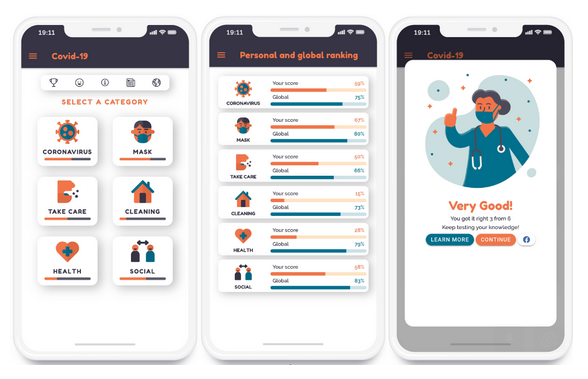
The paper describes the interdisciplinary, collaborative process of creating "COVID-19 - Did You Know?". In short, specialists in health sciences, computing, and design at the Universidade Federal de Minas Gerais (UFMG), Brazil, grouped the game's health recommendations into 6 thematic blocks (Coronavirus, Mask, Take Care, Cleaning, Health, and Social), presented in a quiz format. The software languages were based on the progressive web app (PWA) methodology, and the visual identity, logo, infographics, and icons were developed by considering a selection of colours, typography, sounds, and images deemed suitable for young audiences. Cards with cartoon characters (female and male appearing randomly) were introduced at the end of each thematic topic to interact with the player, reinforcing their correct answers or alerting them to the need to learn more about the disease.
Open data reports of how users interact with the serious game were obtained using the Google Analytics application programming interface. The players' performance was assessed by the rate of incorrect and correct answers and analysed by linear correlation coefficient over 7 weeks. The scrum development methodology enabled daily interactions of developers through a webchat and sequential team meetings.
"COVID-19 - Did You Know?" was made available for free on the UFMG website on April 1 2020 (click here to access it). The game had been accessed 17,571 times as of September 13 2020. Most users were from Brazil (98%). During the 6 months of game analysis, there were 2 months (April and July) in which television and newspaper reports about the game were added to the actions of sending informative emails with the college newsletter. Such dissemination actions, in addition to reports on social media, showed a temporal correspondence with the access number. The game was accessed mostly by smartphones (79.8%), which indicates that it is a good choice to prioritise resources and functionalities for this type of access (vs. computers and tablets).
The correct answer rates for the topics varied between 69% and 89%. Over the weeks of follow-up (July 20 to September 13), the only topic that showed a significant trend was "Mask", with the players' error rate in the topic showing a negative trend (r = -.83; P = .01). Because this study is not a controlled clinical trial, it is not possible to say that the population is more informed about the importance and use of masks; further study is needed, say the researchers.
The second version of the app became available in September 2020; in addition to the Portuguese language, it added English and Spanish language options. Another way in which the researchers sought to increase the reach of the game was to make it accessible to people with visual impairments.
In conclusion, this case study "can provide an example not only to other students and teachers but also for those with future interest in the application of good practices in the development of serious game apps. [The researchers] hope that this game will continue to combat misinformation on the topic of COVID-19 and expand the population's engagement in preventive measures against the disease."
JMIR Serious Games 2020;8(4):e25226. DOI: 10.2196/25226; and email from Juliano De Souza Gaspar to The Communication Initiative on December 29 2020.
- Log in to post comments