










































The Uncertainty Handbook
"Have you ever struggled with the communication of climate change uncertainties? Are you frustrated by climate sceptics using uncertainty - inherent in any area of complex science - as a justification for delaying policy responses?"
This handbook, a collaboration between Climate Outreach and University of Bristol, outlines 12 practical principles for smarter communication about climate change uncertainties. Its purpose is to provide scientists, policymakers, and campaigners with the tools they need to communicate more effectively around climate change. The issue, according to the handbook's creators, is that, although public debate often cites uncertainty as a reason to delay policy action, the reality is very different: Scientific papers have shown that greater scientific uncertainty provides a greater, rather than lesser, impetus for climate mitigation. That is, if we were less certain than we are about what will happen to the climate in the future, then we should try even harder to deal with the problem. The physics and mathematics of the climate system thus point in the opposite direction from people's intuitions. This handbook offers some strategies for closing the gap between people's intuitions and the scientific implications of uncertainty in the climate change debate.
In brief, the 12 principles are:
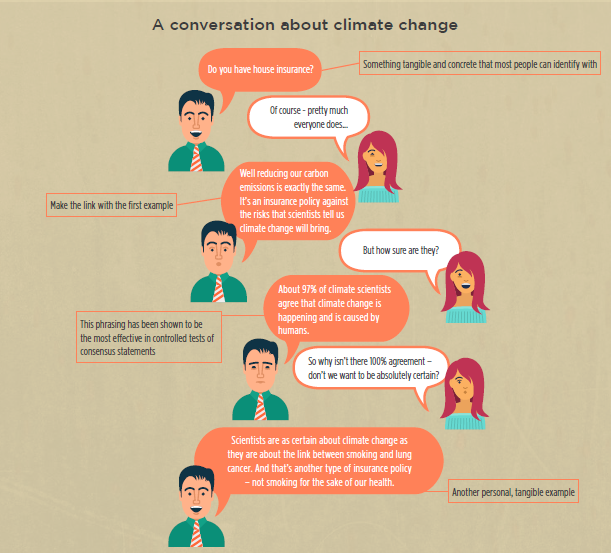
- Manage your audience's expectations - e.g., emphasise that science is an ongoing debate: Just because scientists don't know everything about a subject, they do know something. We know that the climate is changing, and that delaying our response to this increases the risks. Use plenty of analogies from "everyday life" so people can see that uncertainties are everywhere.
- Start with what you know, not what you don't know. If you can, trial or test your messages first to see how they are received; there is no substitute for audience research when it comes to constructing successful climate messages. Use language that resonates with the people you want to engage.
- Be clear about the scientific consensus, which is that humans are causing climate change. Suggested strategies for communicating the scientific consensus: Use a graphic such as a pie chart to visually enhance the message; use a "messenger" who is trustworthy to communicate the consensus; and try to find the closest match between the values of your audience and those of the messenger (see #6).
- Shift from "uncertainty" to "risk", bringing the risks of climate change to life through clear, practical examples (e.g., of the risk of a village flooding, or a farmer's crops being destroyed, or a coastal building slipping into the ocean).
- Be clear what type of uncertainty you are talking about: cause of climate change, climate impacts, or climate policies.
- Understand what is driving people's views about climate change. Uncertainty about climate change is higher among people with right-leaning political values, according to this guidebook. Conservative narratives for embedding uncertain messages about climate change are explored here.
- The most important question for climate impacts is "when?", not "if?". "Having examples of recent flooding, which people have experienced, has made talking about risk with local communities much easier because it's not a matter of 'if' but 'when' and how can we prepare."
- Communicate through images and stories. "A visual artist can capture the concept of sea-level rise better than any graph and still be factually accurate if they use the scientific projections to inform their work."
- Highlight the "positives" of uncertainty, creating hope and emphasising that acting on climate change - even under conditions of uncertainty - entails many co-benefits that most people would support.
- Communicate effectively about climate impacts. "When climate change is present in the stories that people use to discuss their lives, and what they expect from the future, individual climate impacts will more easily slot into them."
- Have a conversation, not an argument.
- Tell a human story, not a scientific one.
Publishers
English, German, Indonesian, Portuguese
20 pages (English)
Climate Outreach website, December 13 2016; and email from Leane de Laigue to The Communication Initiative on December 20 2016.
- Log in to post comments