










































Understanding Governance of Early Childhood Development and Education Systems and Services in Low-Income Countries
Yale University (Britto, Van Ravens, Ponguta, Dimaya), Harvard Graduate School of Education (Yoshikawa, Oh), University of Southern California (Seder)
From the abstract of this UNICEF Innocenti Research Centre working paper: "This initial exploratory study examines the governance and finance of ECS [early childhood services] in three countries using an in-depth qualitative approach. The methodologies and tools provide an innovative strategy built upon the literature of governance and finance to understand how to improve access, quality and equity of ECS. Cross-country analyses reveal key emerging trends in ECD [early childhood development] systems governance at different levels and around crucial dimensions, including actors, coordination, policy architectures, and local-level perspectives. The findings of this study have implications for strengthening systems of global ECD systems research."
This research focuses on the structural systems that provide support, sustainability, and scalability of ECD services, identifying key governance mechanisms of health, education, and protection systems that are linked with improving equity, access, and quality of ECD in Cambodia, Laos, and Kenya.
Researchers used interviews, focus group discussions, and content analyses to address six broad areas of the ECD systems explored: "service goals and implementation, key aspects of governance, governance of finance of ECD, quality of the ECS, historical and ideological understanding of ECD, sociopolitical understandings of governance and finance, and understanding of the association between policies as guiding documents and service implementation."
The document includes:
- a study of main actors in ECD and implications for capacity building. "Our analysis highlighted the need for different forms of capacity building among these actors and variations across the three countries."
- an analysis of horizontal and vertical coordination mechanisms. "[S]ubnationally, between national and village levels (namely, the province and district), the weakest horizontal coordination of government was demonstrated. In Kenya, the presence of provincial and district-level officers and intersectoral committees that focused on coordinated ECD services suggested the emergence of mid-level mechanisms for coordination."
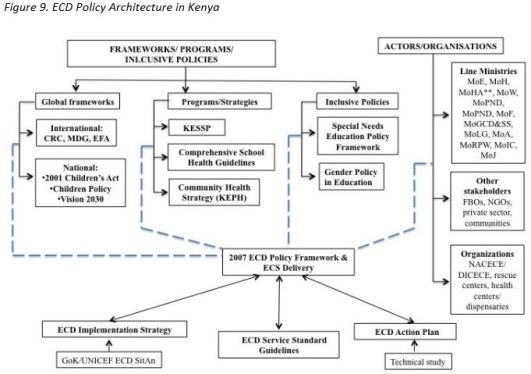
- an exploration of the influence of policy on the coordination function of governance, showing established policies for promoting the governance function of coordination in Kenya and Cambodia, but not in Lao PDR.
- a study of local governance structures as a key lever for ECS improvement and "the role of beneficiaries in governance of ECS."
The conclusions describe ways forward including:
- Competencies of the subnational system-level decisionmakers might be analysed for needs in capacity building, with "an understanding of training and supervision, both pre-service and in-service."
- "[M]apping the policy architecture is an important tool for the field of ECD which can be used for analysis of complex processes."
- More in-country time for research is necessary to map the breadth of geography and population-level comparison of governance.
Bernard van Leer website, August 8 2014.
- Log in to post comments