










































Social and Behavior Change for Family Planning: How to Develop Behavior Change Strategies for Integrating Family Planning into Maternal and Child Health Programs
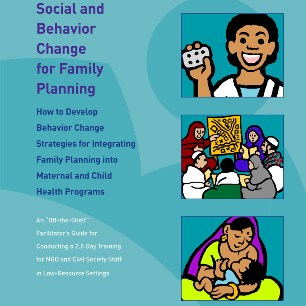
"One way to get started [adding family planning to maternal and child health programmes] is through social and behavior change [BC]. That means learning about the community’s family planning knowledge, attitudes and practices, and then creating strategies based on what is learned."
This group of 3 "off-the-shelf" support documents include a facilitator's guide for staff training, a frequently asked questions (FAQ) list, and a family planning game for use in training on "behavior change basics" and methods. It was formulated by CORE Group with funding from the United States Agency of International Development (USAID).
According to the guide: "A local staff person or team can use this guide to run a 2.5 day training course that teaches the basics of 'designing for behavior change.' This can serve as an energizing starting point for addressing family planning by building skills and helping staff get started in social and behavior change. The concepts and tools can actually be applied to other topics as well, including maternal and child health, nutrition, infectious disease care and control, sanitation, and more."
The "Welcome and Introduction" includes explanations such as "Why focus on social and behavior change strategies?" and includes the following objectives for staff: "Be able to design and conduct formative research; Be able to develop an evidence-based, targeted behavior change strategy to help willing clients adopt family planning; and Have skills and tools needed to plan for implementation of and assess the success of the behavior change strategy." It offers a pre-test to determine pre-training knowledge about developing BC strategies.
The training proceeds in steps with group activities, for example:
Step 1: Understand Behavior Change - Activities might include a role play in which a client comes to get a child vaccinated and inquires about family planning. The provider must tell the client that the services are only available on a certain day or at a different clinic. Subsequent activities train participants on recognising needed changes and processes to create change, using, for example the "Process of Planned Change Cards" (included in the appendices). The final activity in Step 1 gives approaches to "Being a Change Agent".
Other steps are:
Step 2: Develop a Framework for the Behavior Change Strategy
Step 3: Define the Priority Group and Behavior
Step 4: Learn More about the Priority Group and Influencing Group
Step 5: Field Test the Doer/Non-Doer Survey
Step 6: Plan and Conduct a Doer/Non Doer Survey
Step 7: Analyze Data Collected in the Field
Step 8: Develop Your Behavior Change Strategy
Step 9: Implement Your Evidence-Based Strategy
Appendices contain: List of Handouts (HOs) and Training Aids (TAs) and Resources.
The FAQ document contains question2 and answers such as: "How does this relate to the Designing for Behavior Change curriculum and Barrier Analysis tools? No need to reinvent the wheel. This curriculum is based on the frameworks and key concepts of those tools, and has been reviewed by experts in those arenas. If any of your staff has already received any training related to those, or plans to in the future, this training will reinforce what they’ve already learned or will learn."
The Social and Behavior Change for Family Planning Scavenger Hunt corresponds with the Social Behavior Change for Family Planning tool and is a way to engage participants in searching the tool for answers.
Click to access the following:
Publishers
Facilitator's Guide: 185
CORE Group website, January 23 2015.
- Log in to post comments