










































PRECIS: Regional Climate Modelling for Adaptation and Development Planning
"The PRECIS [Providing Regional Climates for Impacts Studies] project is very much motivated by concern about the possible future impacts of climate change and the need to develop adaptation policies in light of scientific predictions of the future. Many developing countries are seen as being the most vulnerable to the impacts of climate change, yet the majority of scientific knowledge concerning future changes is generated in Western nations..."
This case study from the University of Manchester, United Kingdom (UK)'s "Climate Change, Innovation and ICTs" research project, funded by Canada's International Development Research Centre (IDRC) and managed by the University's Centre for Development Informatics (CDI), investigates roll-out of UK-origin climate modelling software to developing countries, providing the basis for many scientific and policy documents.
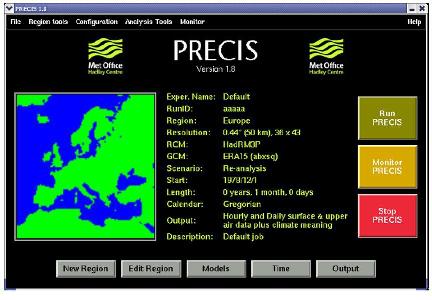
"The PRECIS system is a package consisting of a regional climate model (RCM) and software allowing the processing and display of data on a personal computer. The system is provided free of charge to scientists in developing countries through partnerships between the UK's Meteorological Office Hadley Centre and governmental bodies at the UK and international level. The system is intended to provide developing countries with information on possible future changes in regional climate in order to facilitate adaptation and developing planning.... " Training is provided to prospective users by the Hadley Centre at no cost to the new users, through three international training workshops a year, held regionally, building collaborative working relationships with scientists in neighbouring countries.
"The benefits of this wider distribution of scientific capacity and expertise therefore include the ability of developing country scientists to develop scenarios of future climate change on spatial scales which are perceived as being highly relevant to decision making. However, in interviews with users it became clear that the main advantage of the system is not necessarily the ability to develop policies based on detailed scientific information but, rather, is the generation of awareness of possible climate change impacts in policy communities. The detail which can be provided by the model renders the issue of anthropogenic climate change ‘visible’ - i.e. changes can be visualised on scales of geographical familiarity - and is thus an effective means of persuading decision makers of the need to act."
In the evaluation of the software, the document reports: "The wide uptake of the model certainly renders the project a success in the terms of project's instigators....However, if the project were to be evaluated from a purely scientific standpoint, then further questions arise. For example, it is not commonly accepted within the modelling community that one global climate model can be 'downscaled' through a regional model with equal reliability in all areas of the globe....It is perhaps too early to judge the substantive impact that the modelling activities have had on national policy making despite some examples of model results being used to bolster certain political decisions such as in the Caribbean, where model results have been used to inform the selection of a wind and solar-powered saltwater reverse osmosis system on the island of Bequia to ease anticipated future water shortages, to give one example...."Also, regarding evaluation of uptake, in addition to being free of charge, an enabler in the proliferation of the tool is cited as its alignment with countries' requirements under the United Nations Framework Convention on Climate Change (UNFCCC) and the significance of the United Nations Development Programme (UNDP)'s "seal of approval" in encouraging countries to obtain the model and pursue the related line of work.
The document recommends that: "Prediction must be reconceived from a 'limit' to adaptation..., to an enabler of political discussion about present vulnerabilities and how they may be modulated by changing political and social conditions. " Models, as stated here, can play a useful role in stimulating ideas about how societies may cope with a changing climate and judging which possible futures may be more or less likely. However, the key 'limit' to adaptation is not the knowledge available, but institutional and societal capacities to reduce vulnerabilities to environmental stresses.
Email from Richard Heeks and Angelica Ospina to The Communication Initiative on February 15 2012 and the Nexus for ICTs, Climate Change and Development website on March 27 2012.
- Log in to post comments