










































Open Institute Cambodia: Young Women's Leadership Network
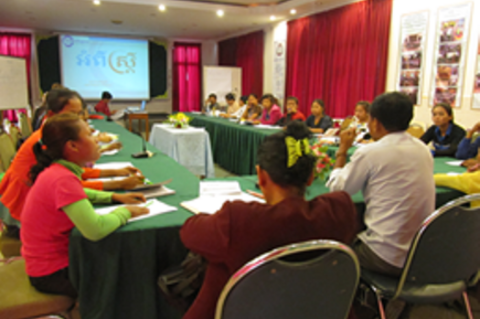
This project "Strengthening Capacity of Young Women’s Leadership Network" (YWLN) aims to increase the participation of young women, including young women and girls living with HIV (YW/GLHIV) and lesbian, bisexual, and transgender (LBT) people, "in political dialogue, and to raise awareness of the rights of YW/GLHIV and LBT people and the need for accountability to gender equality commitments" in Cambodia. The eleven month project, December 2014 to November 2015, is being implemented by the Open Institute in collaboration with partners in Phnom Penh and Battambang, Cambodia, and is funded by United Nations Women. The project includes as beneficiaries young women network members - LBTs, YW/GLHIV, and villagers - as well as network non-governmental organisation (NGO) partners that work with women's rights and issues related to gender and the Cambodian Ministry of Women's Affairs (MoWA).
The project has the following four objectives:
- "Provide ... increased knowledge and skills to raise awareness of the rights of LBT and women and girls living with HIV/AIDS;
- Strengthen dialogue between rights holders and duty bearers at the subnational level to build demand for gender-responsive policy implementation;
- Improve capacity for collective advocacy by ...YW/GLHIV, and young LBTs... which is informed by awareness of their rights and influences public/policy dialogue on HIV and LBT; and
- Increase awareness of women’s human rights in relation to YW/GLHIV and young LBT persons."
Through a meeting of members of the Young Women’s Leadership Network with YW/GLHIV and LBT groups, a common set of messages and agenda began to emerge. Group discussion was conducted among the participants at the partnership engagement meeting to identify challenges, needs, and key messages to be voiced. The messages were: "to stop all forms of discrimination against YW/GLHIV and LBTs" and "that YW/GLHIV and LBTs have the same human rights as other people." Participants voiced challenges, such as: finding support, including family support, for education and healthcare; obtaining ID cards; and being subjected to forced marriages.
The attendees suggested the following needs and interventions:
- A need for "capacity building on HIV and LBT awareness to communities to reduce discrimination against YW/GLHIV and LBT."
- An "LBT request that the government stop discriminating against them and provide them with ID [identity] cards...."
- A need for "educational materials for young girls living with HIV so that they can continue to go to school (they lack text books and other education materials)."
- A request that government "create jobs for YW/GLHIV in communities or at the nearest villages."
- A request to "have vocational training to YW/GLHIV and LBTs to have access to income generated and provide micro finance for them to start their own businesses after the training."
- A request for authorities "to allow the young women, especially YW/GLHIV and LBT, to join commune council’s monthly or quarterly meetings to voice their concern and needs."
- A need for "health care support and ARV [antiretroviral] regularly and free to the YW/GLHIV and LBTs (who are HIV affected)."
The project plans to build participant capacity for joint strategic advocacy on policy issues to address their collective concerns. This includes recognition of the "need to organize, bind together, and mount their actions upon a platform of solidarity. Thus, collective empowerment and action among the most marginalized is an approach that this project will test and attempt to prove as workable. Support will be provided to the development of a common agenda for advocacy and action; the adoption of a shared communication and information strategy; building capacities for advocacy; and pursuing opportunities to influence policy dialogues.... Underlying all of the processes and activities will be a systematic learning-by-doing, mentoring, coaching and technical guidance and capacity building interventions for skills of YWLN to lead joint advocacy and collective communications with YW/GLHIV and LBT."
Education, Health, Gender, HIV, Rights, Women, Youth
"The Cambodian Constitution states the right of all Cambodians to be treated equally. While Cambodian National laws and policies do not identify same-sex activities as a criminal offence, the rights of LGBT’s [lesbian, gay, bisexual, transgender] are not stipulated in any laws or policies. There is no law sanctioning anti-discrimination or punishment for those who violate the rights of LBT people."
Open Institute, UN Women, YWLN, Cambodian People Living with HIV Network (CPN)+, Cambodian Community of Women (CCW), CamASEAN, CHEMS, Khmer Youth for Social Development (KYSD). The project also works with Commune Sangkat Council Association and with National AIDS Authority (NAA) and the United Nations Development Programme (UNDP).
Association for Progressive Communication website and Open Institute website, October 6 2015.
- Log in to post comments