










































Knowledge, Beliefs, Attitudes, and Self-Efficacy: Strengthening an Individual's Ability to Achieve Their Reproductive Intentions
Image
SummaryText
"[F]actors influencing health behaviors exist on multiple levels, are interrelated, and extend beyond the individual."
Accurate knowledge about family planning has long been understood as a critical factor to reach various family planning goals and essential to informed choice. In addition to knowledge, favourable attitudes about and self-efficacy around family planning have been found to influence factors such as voluntary contraceptive uptake and intention to use contraception. As this brief details, implementing interventions to strengthen an individual's ability to fulfil reproductive intentions by addressing their knowledge, beliefs, attitudes, and self-efficacy is one of several proven "high-impact practices" (HIPs) in family planning identified by the HIP Partnership.
Several theories highlight the role of these factors in behaviour change, including the theory of planned behaviour, social learning theory, and the ideational model. Per the HIP Partnership, more research is needed in this area, but, as Table 1 in the brief outlines, social and behaviour change (SBC) programmes addressing knowledge, beliefs, attitudes, and self-efficacy to strengthen an individual's ability to achieve their reproductive intentions have successfully used:
Among the priority research questions listed in the brief: Do SBC interventions, including enhanced family planning counseling models, that address self-efficacy and agency improve various family planning outcomes?
The brief concludes with links to related tools and resources.
Editor's note: A webinar about this HIP brief was held on May 16 2023. Click here to watch a recording of the webinar (also featured below) and/or to download the webinar presentations in PDF format (47 pages).
Accurate knowledge about family planning has long been understood as a critical factor to reach various family planning goals and essential to informed choice. In addition to knowledge, favourable attitudes about and self-efficacy around family planning have been found to influence factors such as voluntary contraceptive uptake and intention to use contraception. As this brief details, implementing interventions to strengthen an individual's ability to fulfil reproductive intentions by addressing their knowledge, beliefs, attitudes, and self-efficacy is one of several proven "high-impact practices" (HIPs) in family planning identified by the HIP Partnership.
Several theories highlight the role of these factors in behaviour change, including the theory of planned behaviour, social learning theory, and the ideational model. Per the HIP Partnership, more research is needed in this area, but, as Table 1 in the brief outlines, social and behaviour change (SBC) programmes addressing knowledge, beliefs, attitudes, and self-efficacy to strengthen an individual's ability to achieve their reproductive intentions have successfully used:
- Mass media (TV, radio, and print): A systematic review found that in 8 of 9 family planning mass media studies, exposure to mass media content was associated with higher levels of knowledge and/or positive attitudes about contraception.
- Multi-level interventions (not including mass media): These interventions use several communication channels and activities addressing factors at different socio-ecological levels (i.e., individual, interpersonal, community, organisational, enabling environment). For example, a study found that the PRACHAR intervention implemented in Bihar, India, increased knowledge and awareness as well as contraceptive use among women exposed to the programme years beyond its end.
- Individual and couples' family planning counseling: For example, an intervention in Ethiopia centred on couples' counseling and monthly community gatherings increased contraceptive use among those who were not using contraception when the study started and improved men's attitudes about women accessing family planning without men's involvement. Experience shows that counseling is most successful when it addresses individual client preferences and needs.
- Community group engagement, participatory group discussions, or workshops: When offered in the form of several sessions engaging community leaders and community members in reflective dialogue about prevailing attitudes and beliefs, this type of intervention not only addresses family planning knowledge, beliefs, and/or attitudes but also social norms.
- Digital tools: For example, an intervention in Nigeria using interactive voice response via phones successfully strengthened self-efficacy to discuss family planning with a provider and led to rejection of myths related to contraception. Experts believe that the impact of interventions using digital tools to achieve family planning goals may be enhanced by pairing digital tools with multi-level intervention components, such as activities to address service and contraceptive access barriers.
- Use formative research to understand local knowledge, beliefs, attitudes, and self-efficacy about family planning.
- Design messages that are culturally appropriate and meaningful to the audience.
- Consider existing levels of individual knowledge about family planning and fertility.
- Address myths and misconceptions directly but carefully.
- Address potential "side benefits" of contraception, including other potential health and lifestyle advantages in addition to addressing barriers or challenges.
- Consider opportunities before, during, and after family planning services to intervene.
- Improve self-efficacy for clients to communicate with family planning providers about their needs, wishes, and questions.
- When seeking to strengthen knowledge, beliefs, attitudes, and self-efficacy among men and boys, recognise their needs as family planning clients, as well as their roles as supportive partners and agents of change.
- Use trusted sources of information.
- Pay particular attention to the needs of diverse adolescents.
Among the priority research questions listed in the brief: Do SBC interventions, including enhanced family planning counseling models, that address self-efficacy and agency improve various family planning outcomes?
The brief concludes with links to related tools and resources.
Editor's note: A webinar about this HIP brief was held on May 16 2023. Click here to watch a recording of the webinar (also featured below) and/or to download the webinar presentations in PDF format (47 pages).
Publishers
Publication Date
Languages
English, Portuguese, Spanish
Number of Pages
9 (English, Portuguese); 10 (Spanish)
Source
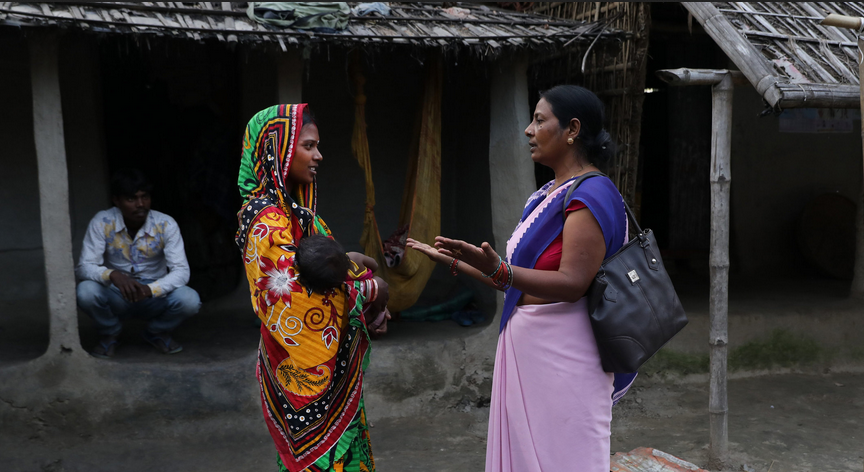
Posting to the IBPnetwork, May 2 2023; and HIP website, May 17 2023. Image caption/credit: An Accredited Social Health Activist (ASHA) interacts with a young mother during a home visit. Credit: Images of Empowerment
- Log in to post comments