










































Internet Access and Training Program (IATP) - Eastern Europe & Central Asia
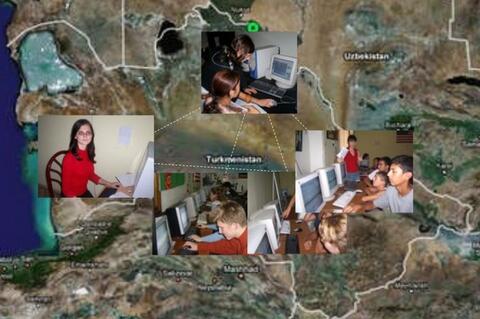
IATP's central approach is to build the capacity of 140 sites located in Armenia, Azerbaijan, Belarus, Georgia, Kazakhstan, Kyrgyzstan, Moldova, Tajikistan, Turkmenistan, and Uzbekistan. IATP access sites are housed in local partner institutions, which include public libraries, universities, and NGOs. These institutions also contribute to community buy-in and support by providing free rent, utilities, and security. An IATP access site usually occupies one room in the partner institution's premises. This room houses all IATP equipment (approximately five computers, a server, a printer, and a scanner), computer-related books and manuals, and an IREX staff member who overseas the operations of the access site. IATP uses a mix of technologies such as dial-up, leased lines, and radiomodem. Each month, approximately 12,608 people use these sites.
IATP undertakes three primary activities, the first of which is the provision of free public Internet access. Users can reserve time in increments of one hour to access e-mail and the Internet, or to use the computers for other purposes such as word processing. IATP also provides dial-up Internet access for alumni of ECA-sponsored exchange programmes (see "Key Points" below). Approximately five hours per day are available for open Internet access. Users at IATP sites volunteer to assist with tasks such as routine computer maintenance and translation of online materials.
Second, members of the public can enroll in a wide variety of training courses on information technology. IATP sites offer weekly courses in basic subjects such as computer literacy, Internet usage, and website development. IATP also offers more advanced training in subjects such as network administration and web programming. Specialised seminars and workshops tie Internet usage to a specific theme (like "Voter Education and the Internet"). Alumni of ECA-sponsored exchange programmes conduct these trainings. On average, 3,602 people are trained each month.
Third, IATP partners with users to create websites and other electronic media. IREX works to develop Internet resources in English but places special emphasis on developing resources in local languages. In addition to the IATP country websites, the programme has developed websites for ECA alumni to serve as online gathering points and to disseminate information about upcoming events (like community outreach activities). IATP also provides training and consultation for local individuals and organisations who wish to create web content. IREX administers an IATP Small Grants Competition to provide support for Internet content development projects. Web projects that receive funding often provide information of a historical, geographical, educational, or cultural nature. 3,220 websites are hosted.
Enabling young people to participate and use IATP services is a key focus. Youth may obtain internships at Internet access centers; engage in self-learning in computer studies; and attend summer Internet Camps where technology is made social, fun, and engaging. To cite a few example, in preparation for the Internet camp in Kazakhstan, IATP trained 70 trainers and secured partnerships with 45 organisations. Over the course of the summer of 2002, more than 1,200 youth participated in the camps. In Kyrgyzstan, a group of schoolchildren from poor families attended a two-week computer and Internet basics training course. And in Uzbekistan, IATP provided Internet and computer training for orphans.
Editor's note, July 6 2016: This programme is no longer in operation. More information about it can be found both here on the IREX Georgia website and here.
Technology, Children, Youth.
IATP began in the mid 1990s. At that time, the programme was aimed at providing Internet access and training exclusively to scholars from Eurasia who had participated in USA government-sponsored exchange programmes. Through its services, IATP helped these exchange programme alumni stay in contact with the professional colleagues they had met while in the United States. Over time, IATP gradually began to provide Internet access and training to non-alumni groups.
In the countries of the former Soviet Union, few individuals have access to the Internet at work (even in capital cities). Access from home is economically prohibitive for most people. Universities generally offer limited Internet access, but these facilities are frequently overwhelmed and available only to students. Internet cafes have sprung up in many capital cities but charge prices that are out of the reach of the average person. Computer resources in many schools are minimal; those that are available are used to teach obsolete computer languages and concepts. Organisers claim that the access that IATP provides takes on even greater importance in light of restrictions like strict government control of mass media and censorship. Furthermore, over 75% of all the information currently available on the Internet is in English, a language that is not widely spoken in many countries of Eurasia.
In Ukraine, 33% of users who participated in an IATP survey reported having been offered a job or promotion as a direct result of the new skills they had obtained through IATP training.
ECA, US Department of State, funded under the FSA; IREX; local partners.
IATP page on the IREX site and project description on the IREX site, both accessed on May 27 2003 but no longer available.
- Log in to post comments