










































How to Design Projects to End Violence against Women and Girls
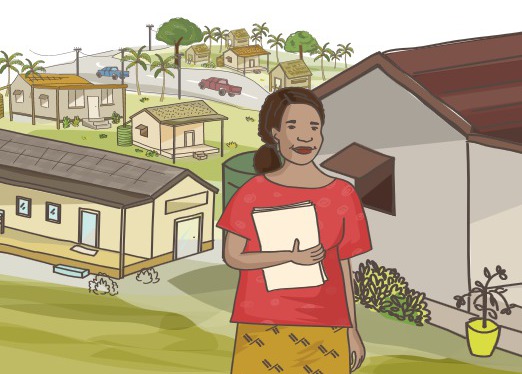
"Follow Moana's story as she uses this Toolkit to help design a project to promote safe and respectful relationships between young people in her community."
This Toolkit brings together information, resources, and practical activities to help Pacific Islanders apply a gendered analysis to the issue of violence against women and to design and implement projects to end violence against women and girls. It was developed by UN Women's Pacific Regional Ending Violence against Women Facility Fund (Pacific Fund) in observation of the fact that, according to UN Women, after years of advocacy by women's rights and civil society organisations, Pacific Island governments have begun to adopt laws and policies to address this issue. However, they face a number of barriers and have a need for capacity building in key areas of project design and implementation.
The Toolkit has five sections. Each section contains information, tools, and activities that relate to a stage of the project cycle:
- Analyse - "In this section you'll gain a deeper understanding of the issue of violence against women and girls and the specific context and needs of your community."
- Plan - "In this section you'll design an effective project with a clear plan to end violence against women and girls in your community."
- Fund - "In this section you'll develop a budget for your project and learn how to successfully apply for grants and funding from donors."
- Act - "In this section you'll implement your project according to plan and use the media to inform the community of your work."
- Reflect - "In this section you'll learn how to monitor and evaluate whether your project has achieved its objectives."
The toolkit will assist in the design of projects that fulfill UN Women's 10 principles of effective project design to end violence against women. At the end of each section is a checklist to help practitioners implement these principles in each stage of the project cycle:
- "Adopt a human rights-based approach - Projects aimed at ending violence against women should be designed and implemented with the understanding that women and girls have equal human rights and that violence against women is a violation of these human rights.
- Apply a gender analysis - Projects aimed at ending violence against women should recognise that gender inequality is the root cause of violence against women and challenge and change the beliefs, attitudes and behaviours that allow it to continue.
- Use a survivor centred approach - Projects aimed at ending violence against women should talk with survivors of violence and take into account the experiences of women and girls throughout the project cycle.
- Follow ethical guidelines- ...Projects aimed at ending violence against women should...respect and protect women's rights to safety, dignity and privacy.
- Be culturally aware - ...Projects aimed at ending violence against women using a human rights based approach should aim to challenge and change cultural beliefs and practices that violate the human rights of women and girls.
- Adapt to different situations - ...Specific strategies should be developed to address different types of violence and the unique experiences of the women who are experiencing it.
- Be inclusive- Projects aimed at ending violence against women should identify and address the specific needs of different groups of women, including those who may be more vulnerable to violence.
- Operate within an ecological model - Projects aimed at ending violence against women should be informed by the ecological model, which explains how a variety of factors at the individual, family, community and societal levels can increase or decrease a woman's risk of experiencing violence. More information about the ecological model can be found on page 43.
- Work in partnership - Projects aimed at ending violence against women should involve partnerships between different stakeholders, such as government, civil society, community and faith based organisations, academic and research institutions.
- Draw on existing evidence - Projects aimed at ending violence against women should be based on evidence and take into account existing research on what has worked and what has not worked in the past."
The reader of the toolkit can follow the experience of fictional Moana (see above), the Programme Officer at the Are'tiki Women's Association, a small, non-government organisation that provides a range of services to support women and girls in the Are'tiki community. "Like many Pacific Island towns and villages, women in Are'tiki face a number of challenges, including fewer educational and economic opportunities, limited access to reproductive health services, poor representation in decision-making and high rates of violence.Recently, there have been rumours going around that a young woman in Are'tiki was raped by her boyfriend. A group of young women from the local school have approached Moana and told her that this is not the first time this kind of thing has happened, but no one ever talks about it..."
Publishers
148
UN Women Asia and the Pacific website, August 1 2016.
- Log in to post comments