










































Guiding Principles on Young People's Participation in Peacebuilding
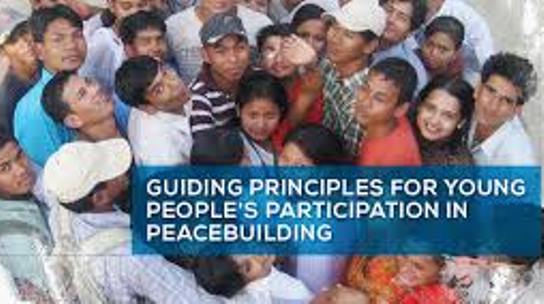
These guidelines from the United Nations (UN) Inter-Agency Network on Youth Development’s (IANYD) Subgroup on Youth Participation in Peacebuilding are intended to provide guidance to UN agencies, governments, and non-governmental organisations (NGOs) in increasing youth engagement in conflict prevention.
The document recommends multiple approaches to involving youth in civic engagement and active citizenship:
- "a human rights-based approach, grounded in the United Nations Convention on the Rights of the Child, the Convention on the Elimination of All Forms of Discrimination against Women (CEDAW) and the World Programme of Action on Youth;
- an economic approach that identifies young people as central to the economic development of their country, and promotes their access to economic opportunities as essential for their own development;
- a socio-political approach that connects young people to civil society and the political arena, and provides them with opportunities, training and support for their active engagement and participation in public life; and
- a sociocultural approach that analyses the roles of young people in existing structures and supports dialogue - including intergenerational dialogue - about these structures."
Principles offering key guidance are elaborated in the document. For example, the over-arching principle of "do no harm" recommends active avoidance of negative consequences for participants, along many recommendations to key actors, including governments; UN entities, funds, and programmes; local, national and international NGOs; civil society actors; and donors. Some communication-based details from the principles include:
- "Promote and abide by the understanding that the majority of young people strive for peace..."
- "Promote sustainable, long-term and collaborative initiatives for and with young people..."
- "Make specific efforts to reach out to marginalized young people within all of these groups; do not assume that elite youth leaders from civil society represent them."
- "Identify strategies to reach out to young women, seek their engagement, and create a safe space to raise their specific issues and concerns and support their initiatives."
- "Create opportunities for young people’s sustained participation, ownership and leadership in local, national, regional and international mechanisms to prevent, manage and resolve conflict and maintain peace."
- "Foster trust and support power-sharing between decision makers and young people, especially through intergenerational dialogue and youth-adult trust-building activities and trainings."
- "Work with young people who are influential among their peers and foster their leadership skills, while simultaneously ensuring the participation of marginalized young people."
- "Facilitate mechanisms, both physical and virtual, for feedback and communication to enable young leaders to be accountable to their peers, communities and partners."
- "Acknowledge the trauma that many young people have suffered, and offer a safe space to share experiences, including access to psychosocial support, justice and other support services for their rehabilitation and reintegration."
- "Ensure that facilitators are specifically trained to handle difficult conversations and situations and know where to refer young people who might need specialized services. "
- "Use tailored and age-appropriate methodologies for young people to contribute directly to designing, implementing, monitoring, evaluating and following up on peacebuilding and post-conflict programmes and processes."
- "Have relevant decision makers, institutions and organizations commit to accountability to young people. Establish mechanisms to communicate with and receive feedback from young people, particularly as part of any youth-focused programme and policy framework."
- "Nurture young people’s skills in leadership, mediation, negotiation, conflict resolution, communication, life skills and positive social norms."
- "Create opportunities for young people to share goals and aspirations with adults in addition to one another; capitalize on their experiences and assets; and engage in multiple areas, including social, emotional, moral, spiritual, civic, vocational, physical, cognitive, personal and cultural development."
- "Increase dialogue, understanding of and opportunities for cooperation among children, young people, parents and elders, in order to act jointly to prevent and resolve violence and transform conflicts."
- "Contribute to the establishment of or support existing local, regional and national forums and other appropriate channels of communication that can enhance young people’s participation in the development of public policies that affect their lives."
The launch of the guidelines by the UN Peacebuilding Support Office and Search for Common Ground, co-chairs of the working group, is aimed:
- "To share the Guiding Principles and their key message of young people’s positive contribution to peacebuilding widely with the international community, particularly with Member States;
- To engage a diverse group of stakeholders in a discussion on the positive contribution of young people to peacebuilding and help garner support for further action at the international and national level; and
- To start engagement of a wide constituency on the development of operational guidance on youth participation in peacebuilding, as a direct follow-up to the Principles.
- To support an active community of practice at the country level for engaging young people’s participation in peacebuilding."
Publishers
Arabic, English, French, Russian, Spanish
4
Common Ground Newsletter - Spring 2014 sent to The Communication Initiative on May 8 2014.
- Log in to post comments