










































Breaking the Inertia in Coverage: Mainstreaming Under-utilized Immunization Strategies in the Middle East and North Africa Region
UNICEF MENA Regional Office (Sadr-Azodi, Senouci); Independent Consultant (DeRoeck)
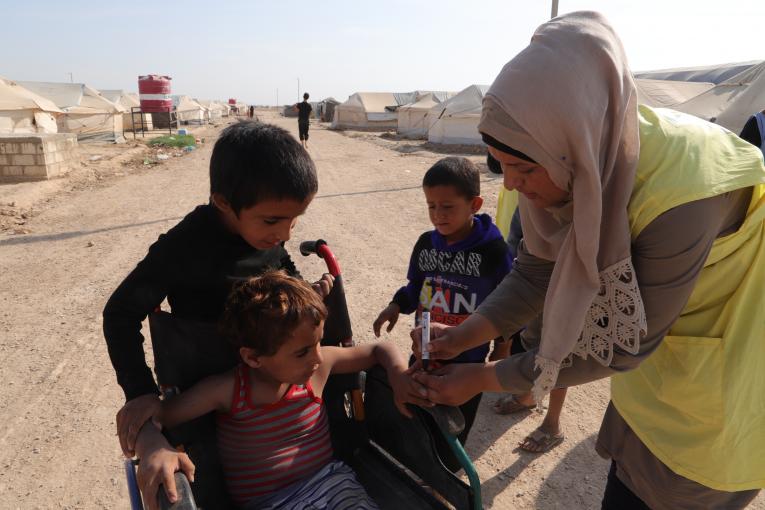
Subnational vaccination coverage data indicate that disparities exist between geographic areas and socio-economic groups in several countries in the United Nations Children's Fund (UNICEF) Middle East and North Africa (MENA) region, with political and economic turmoil as contributing factors. This paper reviews country experiences with 3 strategies that the authors contend could increase vaccination coverage and improve equitable access to services in the middle-income countries (MICs) in the region, especially among marginalised populations. The paper emerges from a regional workshop on Equity-Informed Microplanning, organised by the UNICEF MENA Regional Office with several key partners in September 2017.
The strategies discussed include:
- Intensifying efforts to identify, estimate, and track displaced, mobile, and neglected populations, including: refugees and internally displaced persons (IDPs) fleeing conflict or political unrest, urban slum residents, and nomads and other transient groups in remote locations - The paper outlines the issues, challenges, and possible approaches forward for each group. For example, factors from the literature explaining low coverage in urban slums include the lack of assimilation and social networks among recent migrants and marginalised ethnic groups, social (versus geographic) isolation reducing access to and awareness of health services, and others. There are challenges in reaching children in urban slums, where the constant in- and out-migration complicates efforts to track children's vaccination status and to measure the performance of the immunisation programme in these areas. Potential actions and tools to better account for and include neglected populations like urban slum dwellers in immunisation programmes are: (i) improving the design and implementation of censuses and surveys; (ii) conducting data collection exercises in specific areas; and (iii) using technologies such as geographic information system (GIS) mapping and remote sensing imagery. An example from outside the MENA region is a 3-city project led by a civil society organisation in Pakistan, in which community members mapped out and profiled slum areas and conducted micro-censuses as initial steps to increase vaccination coverage in these areas.
- Finding ways to identify and reduce missed opportunities for vaccination (MOV), including providing and integrating immunisation services during the second year of life (2YL) and beyond - Amongst the most affected by MOV are children (and their caregivers) in hard-to-reach, impoverished, and under-served areas, since they are the least likely to receive regular health services. One of the reasons cited in the literature for the decrease in coverage rates for vaccinations scheduled during 2YL is lack of caregivers' awareness that vaccinations can be given beyond infancy. However, as reported here, providing vaccinations during the 2YL and beyond (e.g., school entry) can help close coverage gaps between residential and socio-economic groups and hence increase overall coverage rates. Many of the activities recommended to address MOV and 2YL vaccinations involve policy changes, such as increasing awareness of parents and the public about MOV and the importance of completing all vaccinations and of retaining vaccination cards/home-based records and bringing them to every contact with health services. The focus in the examples presented here is on the use of data collection and reporting forms and systems designed to facilitate a change in the mindset to "vaccinate children as a default response".
- Engaging with the private/non-governmental health providers in order to improve the coordination, quality, access to, and reporting of immunisation services - In the MENA region, the contribution of the private sector in immunisation seems to be limited or under-reported in some countries. A World Health Organization (WHO) guidance note recommends that countries conduct assessments of the current and potential role of these providers in immunisation, followed by efforts to determine the optimal model of public-private engagement and the establishment of dialogue, collaborative activities, and formal agreements. For example, engaging the private sector by providing training and incentives, such as free vaccines in exchange for administrative data, has been shown in some cases to facilitate reporting from private providers, which could improve the accuracy of vaccination coverage rates.
The authors of this paper believe that immunisation programmes in MENA countries could benefit from employing all or a combination of the presented strategies, actions, and tools. "However, undertaking and scaling up these strategies will require evidence-based advocacy and political will at the country level. In this effort, UNICEF, development partners, academia and civil society are encouraged to coordinate and support countries and immunization programs in generating evidence, influencing policies, mobilizing domestic resources and providing targeted technical and operational assistance."
Vaccine 36 (2018) 4425-32. https://doi.org/10.1016/j.vaccine.2018.05.088. Image credit: © UNICEF/Syria/2019/Ahmad
- Log in to post comments