










































Bangladeshi Association for Life Skills, Income, and Knowledge for Adolescents (BALIKA)
"As an intervention research initiative we chose to offer a package of activities that included the engagement of key actors and mentors from the community and active engagement of a research process to ensure that the effort produced rigorous evidence to inform a learning agenda."
The BALIKA project is a four-arm randomised controlled trial to evaluate whether three skills-building approaches to empower girls - education support, gender-rights awareness training, and livelihoods training - can effectively delay the age at marriage among girls aged 12–18 in 72 communities in three districts of Bangladesh that are considered "hotspots" for early marriage: Khulna, Satkhira, and Narail. Interventions, delivered for 18 months from February 2014 to August 2015, were offered to more than 9,000 adolescent girls, both in school and out of school. Considered to be important gatekeepers and decision-makers, parents (mothers, fathers, guardians, in-laws) of girls and other community leaders from the project areas were also reached through community mobilisation activities. The objective of the programme is to bring about change in girls' lives and their status in the community so that they are perceived as assets rather than as burdens and liabilities to their families and to society. A consortium comprising Population Services and Training Center (PSTC), mPower Social Enterprise (mPower), Center for International Development Issues Nijmegen (CIDIN), and the Population Council partnered on the project.
A global and local literature review and data from the BALIKA baseline survey led to the creation of a theory of change recognising the important role of cultural norms, economic drivers, and institutional context in influencing the processes that result in child marriage. The overall approach is to engage communities by working with local institutions and supportive adults to create a favourable environment to invest in girls. These investments include creating safe spaces, supportive networks, and a common platform that can bring girls together, as well as various skill-building activities.
Intervention activities were designed to test the impact of three different interactive, interpersonal approaches to delaying marriage and childbearing using safe spaces to provide basic skills and access to information and communication technology (ICT) - sometimes using entertainment-education strategies. Community mobilisation activities also provided awareness among community members about the causes and consequences of child marriage and created a platform for advocacy around this issue. (Another 24 communities acted as a control group for the study. Girls in these communities received no services. For full details on the evaluation of this project and its impact, see Related Summaries, below.)
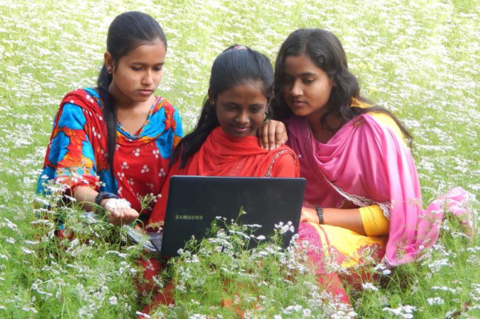
Group sessions for girls were offered through village-based BALIKA centres, which are selected places in primary schools where girls met on a regular basis. The centre offered a safe learning environment where girls received mentor and peer support. All BALIKA centres were run by locally recruited young women (mentors) with the assistance of a teacher affiliated with the school that housed the centre and worked part-time with the project after school hours. Girls met weekly for two-hour-long training sessions. (If families or individual girls felt the centre was too far for them to travel to alone, mentors ensured that sessions were organised so that girls in a particular neighbourhood could walk together. The sessions took place after school hours and on weekends to accommodate competing demands on their time for school and after-school activities.) BALIKA programme interventions included the use of modern equipment, e.g., laptop, tablets, modem, camera, blood pressure machines, digital content, videos, and so on. Sessions attracted the girls living in villages and remote areas, who can now use equipment that they never had seen or touched before. Sessions were highly interactive and lively due to the use of digital content and videos. The centres remained in session throughout the year including during breaks in school sessions, and BALIKA centres can be used to continue sessions after completion of the project.
The basic life skills curriculum - which equipped girls with an integrated set of thinking, personal, and interpersonal competencies needed to lead productive and fulfilling lives - was delivered across all three of the intervention groups. All girls were given basic sexual and reproductive health information in a safe space environment. The 44 hours of sessions included knowing yourself and others, creative thinking, decision-making, learning how to say no, learning to compromise, physical and emotional changes in adolescence, menstrual hygiene, food and nutrition, reproductive health, HIV/AIDS, child marriage, and family planning. Life-skills topics were discussed for the first hour of weekly two-hour sessions, using interactive learning materials and small-group activities. The life-skills module has step-by-step guidelines for conducting the sessions and includes interactive games and group exercises. It guides the teacher and mentors in generating new ideas and in how to make learning entertaining. The module was supplemented by cartoons, comic books, and documentaries. Intended to be fun and thought-provoking, the comic book Sathi (Friend) portrays with pictures the story of an adolescent girl named Sathi and the daily struggles of her life. The hope was that adolescent girls in the groups could relate their own life problems with Sathi and drew motivation and inspiration from her to overcome hurdles. A video documentary Amar Dosh Noi (It Is Not My Fault) on "eve teasing" was created to focus on the issue that presented the ways girls can protect themselves and help those who have been victims of harassment. The aim of this documentary was to create awareness and increase emotional strength among adolescent girls to deal with victim blaming. Another documentary, Akash Chhoyar Sawpno (Reaching the Sky), was created on the topic of self-development for adolescent girls. The objective was to motivate the girls and instill the idea that despite social barriers, with dedication and hard work any goal can be achieved and dreams can be fulfilled.
First, noting that it is well recognised that increasing girls' access to, and motivation for, continued schooling is a key intervention strategy for delaying age at marriage, BALIKA included an education intervention designed to improve school performance by providing specific assistance in mathematics and English. Topics were identified and problem areas were prioritised by experts familiar with the Bangladesh national curriculum. Twenty-four interactive video tutorials were created, each approximately five minutes in length. The flash-based animated contents covered are parts of speech, verbs, prepositions, subject and predicate, sentence-making, tenses, vocabulary, numbers, algebra, and geometry. The materials are intended to assist individual self-learning and increase interest in mathematics and English. The generic materials intended to improve conceptual clarity on these topics for girls in class 6–8. Additionally, existing digital materials from BRAC were used in the sessions. Out-of-school girls were offered a different curriculum, and, if needed, communicative English. The BBC Janala book, used as a tool for practicing English, contained conversations, grammar, pronunciation, vocabulary, quizzes, and practice tests. The out-of-school girls were also taught about financial literacy, including profit, loss, and savings.
Second, grounded in the belief that providing targeted skills training to encourage new aspirations with regard to future economic opportunities for unmarried girls, especially those who had dropped out of school, can help delay marriage, in BALIKA, adolescent girls were given generic livelihoods skills, such as basic computer literacy, email communication, and internet search abilities that can be useful for a variety of economic activities. These skills equipped them with ICT–based livelihoods skills to help construct a different pathway to a productive adulthood. The idea was to give them a basic knowledge of the various skills, which might inspire them to pursue advanced-level training at a later date. BALIKA provided five components of livelihoods skills: basic computing (25 hours), basic health screening (17 hours), mobile phone applications (13 hours), basic photography (30 hours), and entrepreneurship (15 hours). For each component, the programme developed a teachers' guide and students' book. The teachers' guide contained detailed information and was used as a tool to impart entrepreneurship training. The student book which facilitated learning for the students and re-emphasised concepts communicated during sessions.
Third, the gender-rights awareness intervention strategy, based on the Population Council's It's All One Curriculum (see Related Summaries, below), is a rights-based approach that introduces the concepts of sex and gender, gender roles, gender equity and equality, gender discrimination, and gender-based violence. It explores how these concepts have been transmitted and gives girls the opportunity to analyse how gender affects sexual and reproductive health and rights. The topics of child marriage and its consequences, dowry, leadership, mentorship, and role models were also included in the sessions. The teacher/mentor's module aimed to change perceptions and beliefs by discussing gender roles, power dynamics, and gender-based division of labour. Topics were discussed by mentors, and interactive techniques were used to promote participatory learning.
Throughout the intervention period, community discussions led by mentors promoted participation by local government representatives and local leaders in the implementation process and sensitised community members on the importance of the continuation of girls' education and the risk of marrying girls early. Specific community mobilisation components included:
- Awareness-raising activities engaged community members and local leaders from the community. Almost 800 courtyard sessions were organised for parents and guardians of the adolescent girls to inform them about BALIKA's objectives and to highlight the importance of improving the skills of young girls. The meetings also provided opportunities to dispel any misunderstandings about the programme and to address parents' concerns. The sessions provided an opportunity for community conversations about child marriage. Approximately 20 people (mothers and fathers) attended each meeting. Mentors conducted the sessions in the presence of project managers. The meetings also encouraged discussion of sexual and reproductive health and rights (SRHR) issues, life skills, the right of a young woman to live a free life, and the right to consent and have choice with regard to marriage, sex, and childbirth. Also discussed were the importance of girls' regular attendance in the sessions and ways to increase girls’ attendance at BALIKA centres.
- Seventy-two local support groups were formed in the 72 project areas with representation from 13 community members, such as community and religious leaders, teachers, elected government members, matchmakers, marriage registrars, parents, and adolescent girls. Group members met bimonthly to review activities at the centres, support implementation of project activities, encourage girls to stay in school, and provide support to prevent child marriage. Group members discussed the importance of girls' education, legislation and laws related to child marriage, dowry, violence, and reproductive health and rights. Members visited BALIKA centres periodically and addressed any security concerns that may have arisen.
- A total of 255 advocacy meetings were conducted in the 72 unions to engage communities in discussions about child marriage and to increase awareness of the value of education, life skills, and livelihood opportunities for girls. Project activities were shared by staff and the community. Attending the meetings were upazila chairmen and government officials, union council chairmen, local female ward counselors, kazi (Muslim marriage registrar), puro-hit (Hindu priest), imam (Muslim religious leader), lawyers, head teachers of primary and secondary schools, matchmakers, non-governmental organisation (NGO) workers, and young boys and girls. Discussions centred on the roles and responsibilities of individuals in the society as well as those of local representatives and government officials.
- Project staff and BALIKA centre girls participated jointly with the local government in such observation events as National and International Girl Child Day and National Victory Day. BALIKA members and mentors actively took part in rallies, debate competitions, cultural activities, writing and signing competitions, and more.
- As part of local-level advocacy, three workshops were organised at the district level in Khulna, Satkhira, and Narail to share project updates, monitor strategy, and disseminate baseline survey results to stakeholders and local government officials, to ensure their support and cooperation.
- A national-level dissemination and advocacy event was organised to share the findings of the baseline results and engage ideas and expanded opportunities for adolescent girls. Stakeholders from government, NGOs, donors, and private-sector professionals attended the event. Additionally, BALIKA project staff participated in different national and international forums and presented an overview of the project.
- A website enabled teachers to download the curriculum directly from the Internet. The site also included animation developed by the project. Providing a visual representation of characters and their problems helped students more easily grasp related educational materials.
A comprehensive four-day residential training on basic life skills was imparted to in-school and out-of-school mentors in several batches. The training included the contents of the basic life-skills module, basic class management, and computer and tablet usage. Additionally, mentors received training on gender rights, education, or livelihoods, depending on their categories. Training of Trainers on gender rights and awareness consisted of three-day-long intensive trainings with topics including: the difference between sex and gender, gender norms, gender equality, gender discrimination, gender-based violence, "eve teasing", and the consequences of child marriage. The livelihoods intervention offered five different types of training: basic computing, basic health screening, mobile phone-based applications, basic photography, and entrepreneurship. The trainings were based on the resource books that were developed by the project and included the teacher's guide and the session plan. Expert resource persons were hired for photography and health training. The training was made interactive by role play and practical application of materials. Emphasis was on the use of technology, especially computer skills, as the project used various digital contents prepared by mPower. A refresher training was also conducted at the end of the first year for the mentors.
Apart from the yearly training for mentors, weekly practice training sessions were organised to improve the overall session quality and facilitation skills of mentors. Regular session monitoring visits by managers, senior research officers, and monitoring officers suggested that continuous training and feedback would enhance the knowledge and skills of the mentors on topics to be delivered at BALIKA centres. Once a week, mentors from all the unions gathered at the upazila office and participated in mock sessions in the presence of their supervising managers. The mentors demonstrated their preparations for the following week. They gave feedback to each other and received suggestions from the managers on content and presentation skills in order to improve the quality of the sessions.
Child Marriage, Gender, Rights, Education, Economic Development
According to the Population Council, "[t]wo out of three girls in Bangladesh are married before the legal age of 18. Child marriage forces girls into sexual relationships for which they are not physically or emotionally prepared. It can cause them to drop out of school and it limits their opportunities for community participation, including employment. A delayed marriage greatly improves a girl's chances for a healthy, happy, productive life. And the benefits of a later marriage go beyond the girl: her children, family, community, and country experience better health, economic, and social outcomes....The practice of child marriage is influenced by community norms and beliefs, household poverty, and a lack of individual opportunities for girls and women. Norms and beliefs may support and be supported by poor access to positive alternatives, such as schooling and work for young girls."
The results are detailed in the full evaluation, available through the Related Summaries link, below. In brief, girls who received extra tutoring or gender-rights awareness training were 31% less likely to be married, and those who received jobs training were 23% less likely to marry.
Thirty-four communities involved in the project have decided to continue supporting girls in some way after the 18-month period, such as paying for mentors or for teachers to continue to run the training programmes. One local government has actually budgeted to spend 10% of its budget on women and girls. The hope is that the BALIKA centres will continue to be run by the teachers, mentors and community leaders who participated in the project, thereby helping empower thousands more girls by continuing to offer skills, provide education support, and build confidence.
The Population Council, Population Services and Training Center (PSTC), Centre for International Development Issues Nijmegen (CIDIN), and mPower Social Enterprises. The BALIKA project was made possible by support to the Population Council from the Embassy of the Kingdom of the Netherlands. The project is also supported by the Ministry of Women and Children Affairs, Department of Women Affairs, Government of the People's Republic of Bangladesh.
Email from the Population Council to The Communication Initiative on April 25 2016; Population Council website, April 25 2016; and Delaying Child Marriage through Community-Based Skills-Development Programs for Girls: Results from a Randomized Controlled Study in Rural Bangladesh, by Sajeda Amin, Johana Ahmed, Jyotirmoy Saha, Md. Irfan Hossain, and Eashita Haque, Population Council, April 2016. Image credit: Lachmin, BALIKA member, Naldi, Narail
- Log in to post comments